
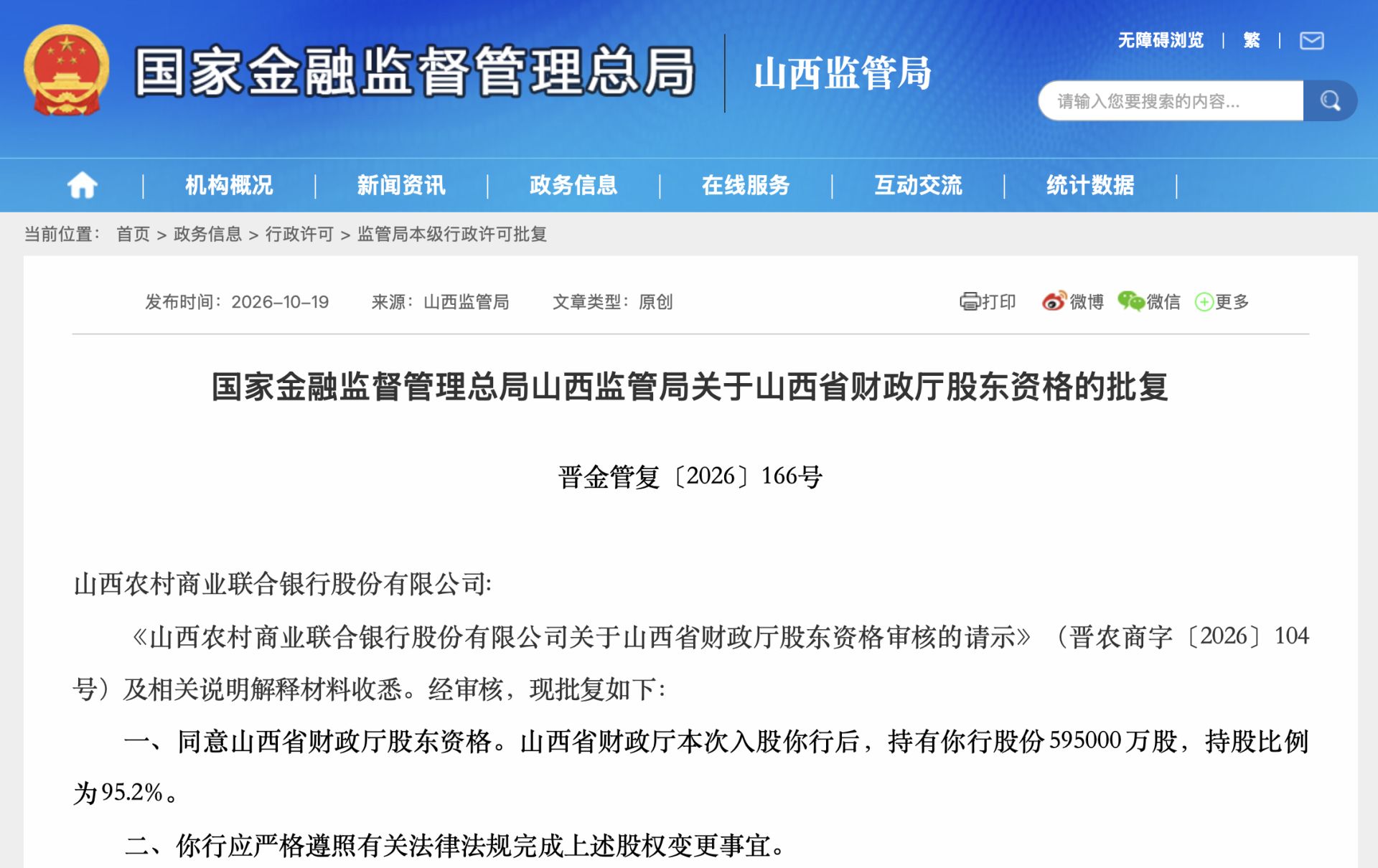
This is a shareholding increase that can be traced. According to reports from a reporter at Every Economy, as of the end of the first half of 2026, the Shanxi Provincial Department of Finance, Shanxi Xinghuacun Fenjiu Group, and Shanxi Publishing & Media
1.25 billion shares of additional holdingsApproved, the equity of two minority shareholders was passively diluted.
Based on the latest approved calculations, the Shanxi Provincial Department of Finance has newly acquired 1.25 billion shares, thereby increasing the bank’s total share capital to 6.25 billion shares. Against this backdrop of an expanded share base, the equity stakes of the two provincial state-owned enterprises that did not participate in this capital increase will be passively diluted: Fenjiu Group’s holding will decrease to 3.2%, and Shanxi Publishing & Media Group’s stake will fall to 1.6%. Once the equity changes are duly completed in accordance with the law, the bank’s registered capital is expected to rise from RMB 5.0 billion to RMB 6.25 billion.
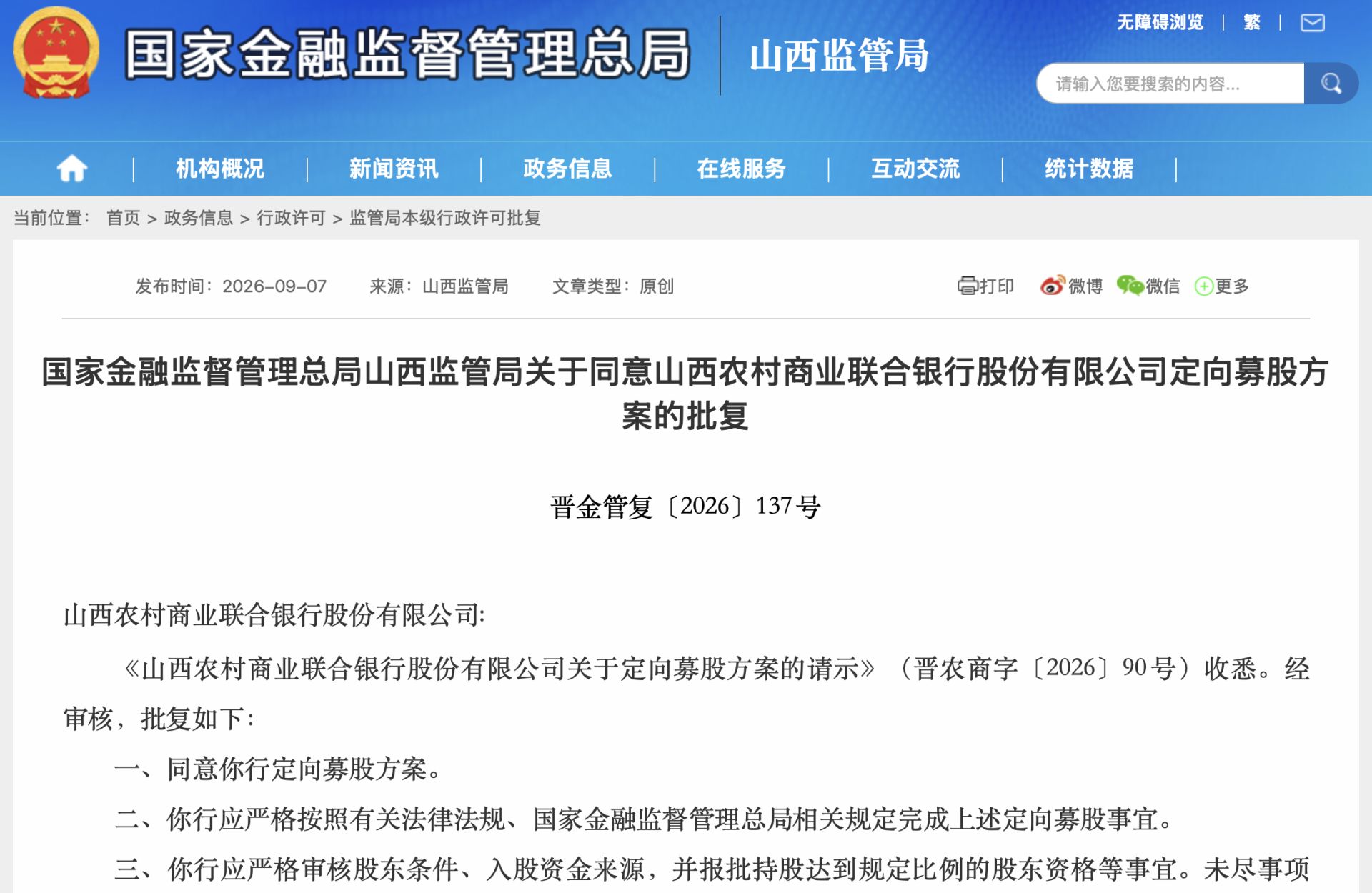
Notably, the approval of the shareholders’ qualifications had been foreshadowed. On September 7, the Shanxi Regulatory Bureau issued an official reply approving Shanxi Rural Commercial Joint Bank’s targeted share‑raising plan and mandating that the bank rigorously vet both shareholder eligibility and the sources of funds for share subscriptions. From the approval of the share‑raising plan to the final confirmation of shareholder qualifications, only a little over a month elapsed, underscoring the bank’s swift and tightly scheduled capital‑increase process.
Behind the Capital Increase: The Urgent Need for Capital During the Risk-Resolution Phase
Shanxi Rural Commercial Joint Bank was officially inaugurated on November 17, 2023. Established on the foundation of the former Shanxi Provincial Rural Credit Cooperatives Union, it is among the first batch of rural commercial joint banks nationwide to adopt the “top‑down participation” restructuring model. Under the authorization of the provincial government, it exercises management, guidance, coordination, and service functions over the rural commercial banks and rural credit cooperatives within its jurisdiction. According to its official website, the bank oversees 108 county‑level legal entities, including 102 rural commercial banks and 6 county credit unions, with a total of 2,855 operating outlets.
The key to the “top‑down participation” model lies in ensuring that provincial‑level platforms possess sufficient capital capacity to take equity stakes in county‑level legal entities, thereby leveraging equity ties to restructure governance frameworks and mitigate existing risks. This approach entails a sustained capital outlay. According to the bank’s 2025 annual report, by year‑end 2025 it had invested in 10 county‑level institutions; in September this year, its shareholder qualification to acquire a stake in Shanxi Liulin Rural Commercial Bank was approved, raising its ownership to 46.01%—just one step away from achieving controlling interest.
A senior industry insider at a medium‑sized bank in the western region told a reporter from the China Business News that, from a logical standpoint, the provincial finance’s decision to inject additional capital at this juncture is a preemptive move: the provincial-level rural commercial joint bank does not directly engage in deposit‑taking or lending; every penny it allocates to equity investments and risk‑mitigation measures must be underpinned by its own capital base. “The fatter the management platform’s financial cushion, the greater its capacity to channel support downstream and manage risks,” he said. In his view, the timing of this capital increase—aligned with equity‑investment projects such as those involving Liulin Rural Commercial Bank—signals that Shanxi’s rural credit cooperative reform is shifting from the stage of “building the framework” to the substantive phase of “bolstering capital and consolidating controlling stakes.”
The bank’s strong operating fundamentals also underpinned its capital increase. According to the bank’s disclosed data, as of June 30, 2026, the total deposits across all county-level legal entities in the system amounted to RMB 1,485.805 billion, a net increase of RMB 62.711 billion from the beginning of the year; total loans stood at RMB 949.504 billion, up RMB 36.564 billion from the start of the year. The 2025 annual report indicated that, by year-end 2025, the system-wide non‑performing loan ratio had declined by 15 basis points from the beginning of the year to 3.29%. Furthermore, three high‑risk institutions—Pingyao, Shouyang, and Tianzhen—had brought their key regulatory indicators into compliance with risk‑mitigation standards, while two city‑level credit unions—Yuncheng and Xinzhou—completed market‑based exits. During the year, no new risk events were reported among rural and township banks within the province.
With equity highly concentrated, two critical challenges—corporate governance and capital management—remain to be addressed.
A 95.2% shareholding ratio indicates that the equity structure of Shanxi Rural Commercial Joint Bank has become even more heavily concentrated in the provincial treasury. Within the broader context of provincial credit union reforms nationwide, such a degree of concentration is relatively rare.
The aforementioned industry insider believes that the advantages of absolute fiscal control are self‑evident: it enables a more direct transmission of reform directives and shortens the decision‑making chain for risk resolution, making this structure pragmatically sound during critical phases of risk mitigation. However, he also cautions that the greater the concentration of equity, the higher the internal governance constraints required. “As rural commercial joint banks seek to take minority stakes in numerous county‑level institutions, the boundaries of related‑party transactions between shareholders and the bank, as well as between the bank and its investee entities, must be clearly defined; otherwise, the equity linkages could inadvertently become conduits for risk transmission.”
The wording of the regulatory authority’s approval underscores this concern. While approving the shareholders’ qualifications, the approval explicitly requires the bank to strengthen its equity management, further optimize its shareholding structure, strictly control related-party transactions, and enhance its corporate governance and internal control mechanisms to prevent and mitigate risks. With the equity arrangement now finalized, whether governance can keep pace will be pivotal in the second phase of the reform.
Another challenge lies on the capital side. Annual report data show that, as of year-end 2025, the system‑wide consolidated capital adequacy ratio stood at 10.37%, underscoring the need to continue strengthening its robust capital buffer. With a non‑performing loan ratio of 3.29%—still above the commercial banking sector average—the bank faces three capital‑intensive priorities: reducing NPLs, increasing provisions, and replenishing capital. This round of capital injections from provincial treasuries has undoubtedly provided the institution with greater flexibility; however, whether it can translate this additional capital into genuine risk‑mitigation capacity at the county‑level branch level—rather than merely reflecting changes in equity figures—remains to be seen.
From its public listing in 2023 to the present, as its registered capital is poised to surpass RMB 6.25 billion, the reform trajectory of Shanxi Rural Credit Cooperatives has become increasingly clear: leveraging a provincial‑level platform as the central hub and capital as the connecting link, it is consolidating equity at the grassroots level, strengthening governance, and mitigating risks. Now in the mid‑stage of this strategic initiative, each move is being executed with growing precision; and the quality of capital and the caliber of governance at every step will ultimately determine the overall success of this reform.
Cover image source: Every Economy Media Asset Library